Educational content notice: This article is for general financial education purposes only and does not constitute personalized financial, investment, or tax advice. Individual circumstances vary. For guidance specific to your situation, consult a qualified professional or connect with the Horizon Growth team directly.
Online investing communities are full of a familiar complaint: someone has followed the advice for years — contributing regularly, staying diversified, avoiding panic decisions — and the growth still feels painfully slow. Their frustration is not unreasonable. Compounding is mathematically real, but for most of its timeline, it is emotionally invisible.
This is not a lack of commitment. It is simply what it feels like to be early in a very long process. That distinction matters, because it changes the question from “is this working?” to “how do I stay in it long enough to find out?”
The Psychology of Long-Term Investing: Why the Middle Feels Like Fatigue
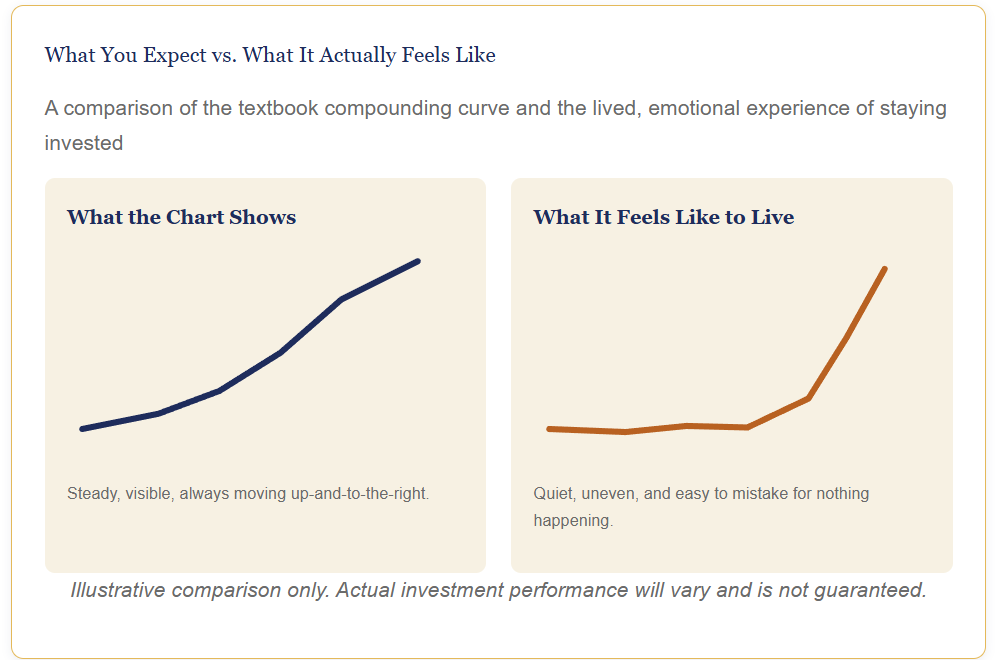
Growth curves look smooth on paper. In real life, they feel flat for years, then suddenly steep. Because of this, many people mistake the quiet, early stretch of their plan for failure and step away right before the results would have shown up.
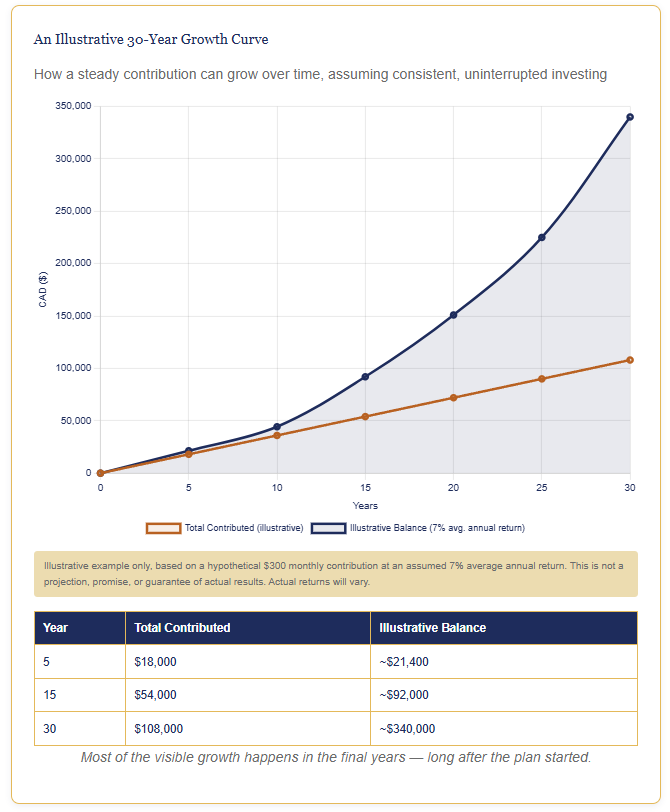
This is exactly where the psychology of long-term investing becomes more important than the arithmetic behind it. The formula for compounding does not change based on how someone feels about it. Their behaviour during the flat stretch, however, changes everything.
What Compounding Fatigue Actually Looks Like
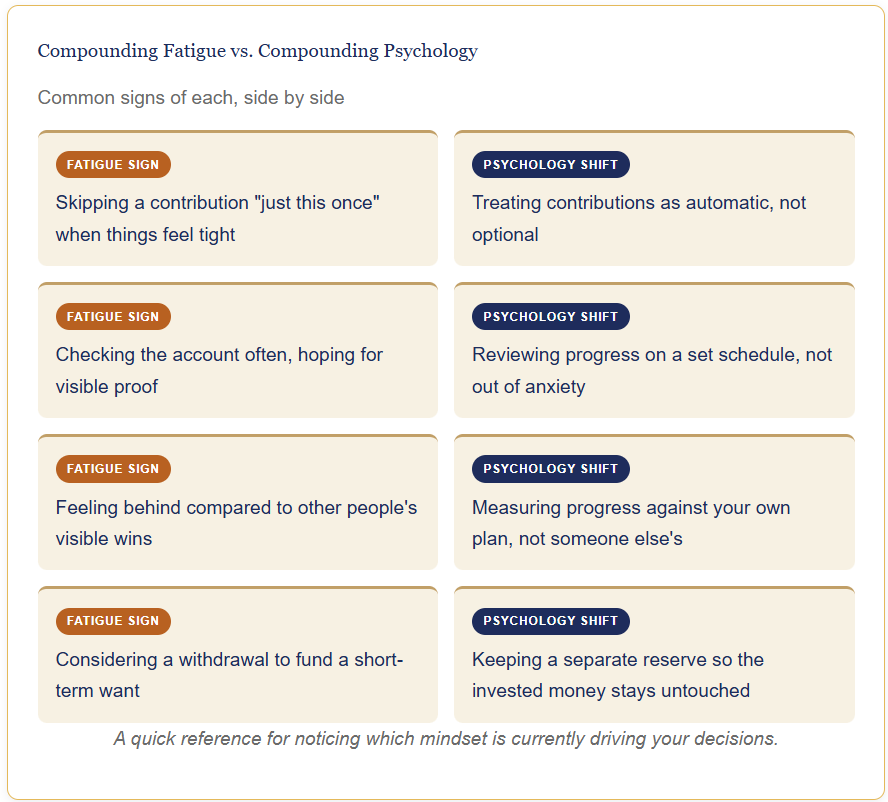
Compounding fatigue rarely arrives as one dramatic decision. It shows up as small erosions instead. Small erosions such as pausing a contribution during a busy month, withdrawing funds for something urgent, or quietly losing interest in reviewing a portfolio that never seems to move.
Financial institutions rarely flag these moments. There is no alert when someone quietly stops contributing for a season. There is no warning when a small withdrawal becomes a habit. As a result, the erosion is easy to miss until years later, when the outcome looks noticeably smaller than expected.
Staying Consistent With Investing Isn’t a Personality Trait
Many people assume that staying consistent with investing requires unusual willpower. In practice, the people who sustain a long-term plan rarely rely on willpower alone. Instead, they build habits, support systems, and a clear enough understanding of their own finances that consistency becomes the easier choice.
This distinction matters. Discipline that depends on motivation tends to fade over time. Discipline that is built into a system — automatic contributions, a trusted advisor relationship, ongoing financial education — tends to hold up, even while the results are still out of view.
For many first-generation Canadians in particular, this challenge is compounded by an unfamiliar system. Understanding how registered accounts, taxation, and long-term investing work in a new country takes real time on its own, well before consistency even becomes possible.
From Kenya to Canada: Building Financial Discipline From Zero
Esther Sande’s own introduction to this idea did not begin in a classroom. It began in 2010, when she arrived in Canada from Kenya with no prior exposure to the Canadian financial system.
There was no existing framework to lean on. There were no existing framework for taxes, investment accounts, for the everyday financial decisions Canadians are expected to navigate. Every concept, had to be learned from the ground up, one lesson at a time.
That process was, by its nature, slow. It required patience long before it produced any visible results. This is precisely the same psychology of long-term investing she now shares with the families and business owners she works with today.
Esther has often described this period as one defined by small, repeated efforts rather than sudden breakthroughs. She read, she asked questions, and she slowly pieced together an understanding of a system that was never explained to her directly.
The Four Pillars Esther Built Before Her Portfolio Grew
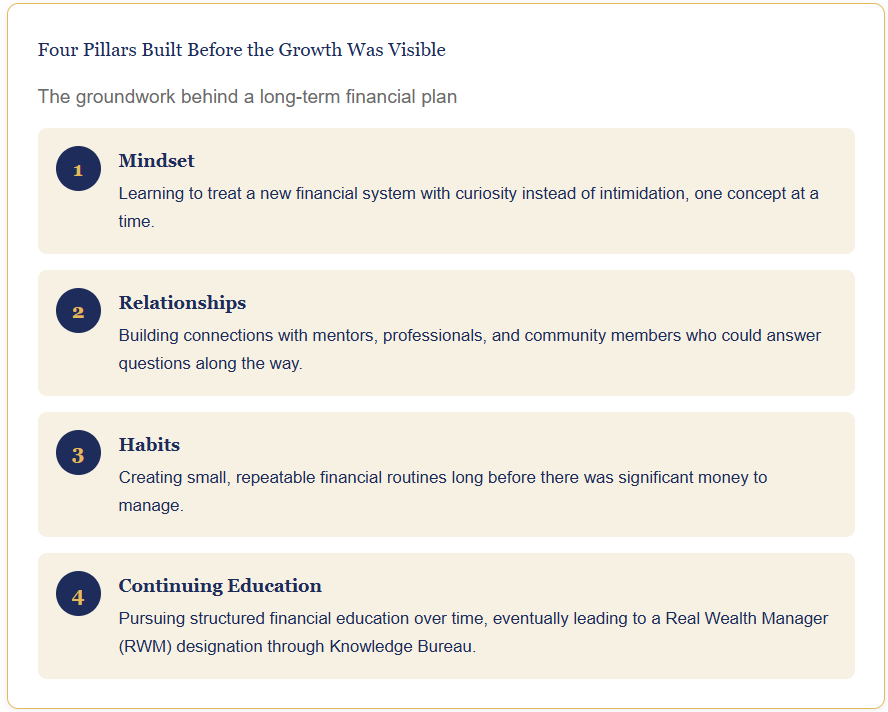
Long before any account balance reflected the effort, there are four things were quietly being built in the background.
Each of these pillars mattered more than any single investment decision. Together, they created the conditions under which consistency was possible — and, eventually, gave compounding something real to work with.
None of these pillars produced an immediate financial result on their own. Instead, each one made the next stage of the journey more sustainable, which is precisely how the psychology of long-term investing is meant to work.
Where the Psychology of Long-Term Investing Took Center Stage
The evening brought together voices from across the financial industry, including Evelyn Jacks, founder of Knowledge Bureau, alongside representatives from Manulife and Canada Life, and members of the BNI Elevate network.
Guests moved through an evening that combined education, celebration, and genuine business networking. Speakers addressed topics ranging from entrepreneurship to financial protection, and each one reinforced the same underlying idea Esther would return to during her own keynote.
During her keynote address, Esther shared the same message that shapes this article:
“The life you desire is not built on one extraordinary moment. It is built through ordinary decisions made consistently over time.”
“The life you desire is not built on one extraordinary moment. It is built through ordinary decisions made consistently over time.”
— Esther Sande, keynote address, launch of The Psychology of Compounding
The night closed with an official book launch ceremony and a room full of people who, in one way or another, understood exactly what that sentence meant.
For attendees, the evening offered more than a book to purchase. It offered a working example of what patience looks like once it finally becomes visible — proof that the years many people question along the way do eventually add up.
Ready to Build Your Own Psychology of Long-Term Investing?
Every long-term investor eventually faces some version of the fatigue described in this article. What separates those who stay the course is rarely intelligence or income. More often, it is the same ordinary consistency — practiced quietly, over years — that shaped Esther’s own journey.
Not through one dramatic decision, but through the same ordinary consistency Esther describes throughout her book. For readers who want to explore this thinking further, The Psychology of Compounding is now available. For anyone who wants to experience the evening itself — the keynote, the industry speakers, and the official launch ceremony — the full event replay is also available to watch.
Disclaimer: This article is intended for general financial education purposes only and does not constitute personalized financial, investment, or tax advice. Illustrative figures and examples referenced in this article are hypothetical and are not guarantees of future performance. Please consult a qualified professional or connect with Horizon Growth directly for guidance specific to your situation.
Parkinson’s Law is silently wrecking your finances. Discover how this mindset trap causes high earners to overspend and learn 3 powerful strategies to save more, build wealth, and stay financially disciplined.
2025 Canada Money Facts – Get the latest TFSA, RRSP, FHSA, CPP, OAS, and RESP limits. Stay informed on savings, pensions, and benefits for the year ahead!
Get ready for tax season with our 2024 guide! Discover actionable tips for families, retirees, students, and investors, including insights on TFSAs, RRSPs, capital gains changes, and much more. Don’t miss these strategies to make the most of your tax year.
Stay updated on 2024-2025 Canadian corporate tax rates for CCPCs. Small business rates start at 9%, active business varies, and investment income is 38.7%.
Discover essential 2024 tax strategies tailored for business owners! From optimizing compensation and preserving the Small Business Deduction to maximizing the Lifetime Capital Gains Exemption, these tips can help save on taxes while planning for your business’s future.